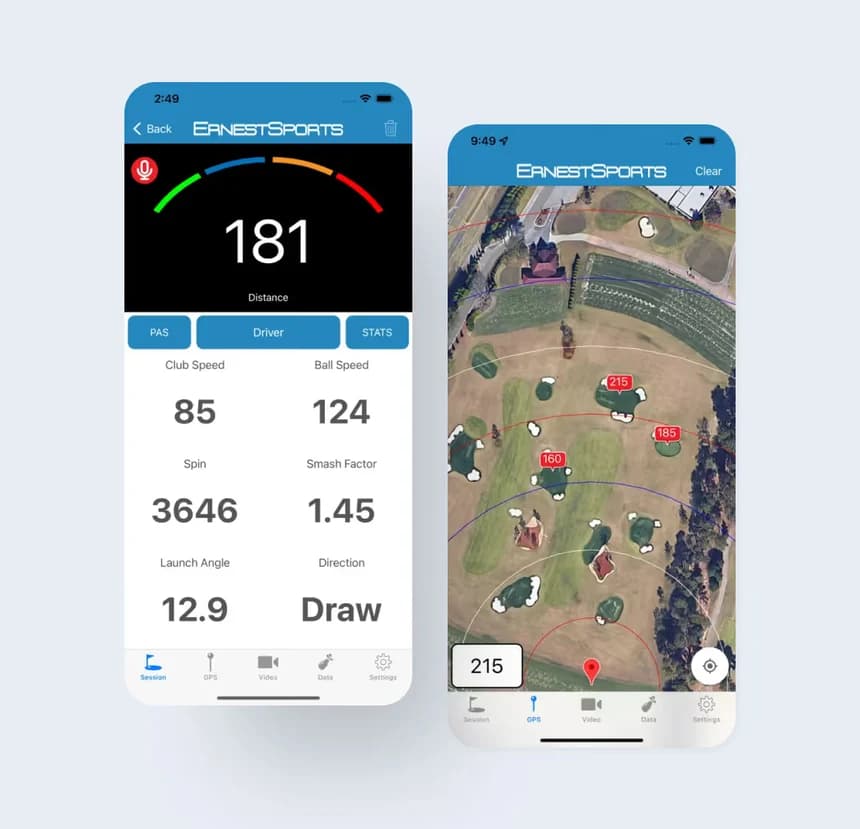
Ball speed sets your distance ceiling, smash factor tells you how efficiently you transferred club speed into it, and spin rate plus launch angle decide how much of that distance you actually keep. Club path and face angle together explain which way the ball curves.
The distance group
Ball speed
How fast the ball leaves the face, in miles per hour. This is the single strongest predictor of how far a shot goes. A tour player hits a driver around 165 to 175 mph; a mid handicap golfer is usually 130 to 150.
Smash factor
Ball speed divided by club speed. It measures strike quality, not power. The theoretical driver ceiling is about 1.50, and 1.45 or better is a well-struck drive. If your club speed is high and your smash factor is low, you are missing the centre of the face, and more speed will not fix it.
The flight group
Launch angle
The vertical angle the ball leaves at, in degrees. Driver launch is usually best between 12 and 16 degrees for most amateur swing speeds.
Spin rate
Backspin in revolutions per minute. This is the metric golfers most often ignore and most often need. Roughly 2,200 to 2,800 rpm is a productive driver window; wedges will spin three to four times that.
Apex and descent angle
How high the shot peaks and how steeply it lands. Descent angle determines whether an iron shot holds a green or releases through the back.
The direction group
Club path
Whether the clubhead is travelling left or right of the target line through impact. Negative is out-to-in, positive is in-to-out.
Face angle
Where the face is pointing at impact relative to that path. Face angle starts the ball; the difference between face and path curves it.
What to work on first
- Get smash factor up. Centre contact is free distance and it makes every other number more reliable.
- Then look at spin. Most amateurs lose twenty yards of driver carry to spin that is too high.
- Then launch angle, usually fixed by ball position and attack angle rather than by swinging differently.
- Only then worry about path and face, which are the hardest to change and easiest to over-analyse.
Every Ernest Sports launch monitor measures the distance group. The ESB2 and above add club path and face angle.
Frequently asked
What is a good smash factor?
About 1.45 or better with a driver indicates a well-struck shot. The theoretical maximum is around 1.50.
What spin rate should I have with a driver?
Roughly 2,200 to 2,800 rpm suits most amateur swing speeds. Higher spin causes the ball to climb and fall short.
What is the difference between club path and face angle?
Club path is the direction the clubhead travels through impact. Face angle is where the face points at impact. Face angle starts the ball and the gap between the two curves it.